Bluetooth Integration for an Industrial Measurement Device
Embedded C firmware improvements for a Bluetooth interface in an industrial gas-analysis and pressure measurement device, providing a robust wireless alternative to the existing serial connection.
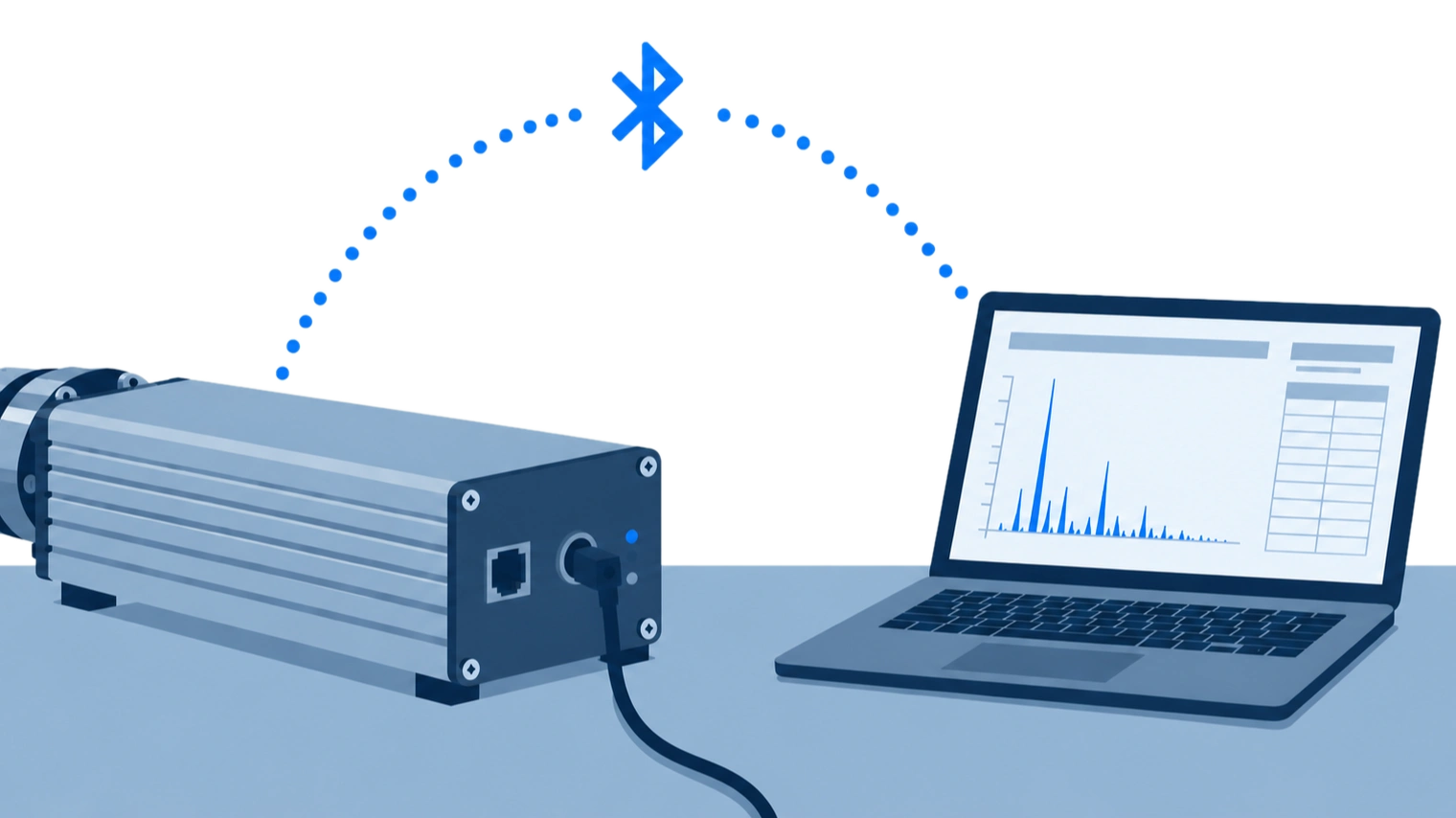
- Took over and improved a partially functional Bluetooth implementation in an existing measurement device
- Improved communication robustness, initialization, connection handling and error recovery
- Integrated the wireless path transparently with the device's existing proprietary communication protocol
- Enabled the existing PC software to communicate wirelessly through a virtual COM port
Context
An industrial measurement device for residual-gas analysis and pressure measurement used a central controller board to coordinate communication between its internal electronics and external systems such as a PC running the measurement and data-display software.
For applications such as laboratory setups, some customers required a cable-free connection between the measurement device and the PC. Bluetooth was therefore included as an additional communication option alongside the existing wired serial interfaces.
The hardware had already been designed to accommodate a Microchip RN42-I/RM Bluetooth 2.1 + EDR module. I took over the project at a stage where the Bluetooth implementation was already partially functional but still suffered from communication and connection-related problems.
My Role
My responsibility was focused on the embedded firmware integration and on making the existing Bluetooth functionality more robust.
Working in C on an AT91SAM7-series microcontroller, I partially rewrote and extended the interface to the Bluetooth module together with contributions from other engineers.
My work included improvements to:
- module initialization and configuration
- UART communication
- connection-state handling
- asynchronous module responses
- timeouts and retries
- communication error handling
- connection recovery
- Bluetooth activation and deactivation
I also verified that the selected Bluetooth module remained available for production. The Bluetooth hardware and PCB integration had already been designed before I took over the project.
Communication Architecture
The measurement device already used a proprietary protocol for communication with the PC software. Rather than introducing a separate application protocol for Bluetooth, the existing device protocol was transported through the Bluetooth connection.
The communication path was effectively:
Device Protocol → UART → RN42 Bluetooth Module → Bluetooth → Virtual COM Port → PC Software
On the PC, the Bluetooth connection appeared as a serial COM port. This allowed the existing measurement software to communicate with the device in essentially the same way as through a cable, without requiring a separate Bluetooth-specific application interface.
Through this connection, the PC software could receive the device’s measurement and status information, including gas-analysis data, pressure values and errors. The same communication path could also be used for device configuration, such as setting warning thresholds and controlling available communication methods.
Integration with Existing Interfaces
Bluetooth was designed as an additional communication option, not as a replacement for the existing wired interfaces.
The firmware therefore had to integrate the wireless path into an established communication system while preserving the existing serial communication options, including RS232 and RS485.
Part of my work was improving the control of the Bluetooth interface itself. The module was kept disabled by default after initialization and could subsequently be activated when required through the device’s communication and configuration logic.
Reliability Improvements
The main technical task was not implementing Bluetooth from a blank project, but taking over a partially working system and resolving the weaknesses that prevented it from operating reliably.
I revised parts of the existing firmware to improve communication robustness and reduce connection-related errors. This included handling module responses and connection states more consistently, improving error and timeout behavior, and ensuring that the firmware could recover correctly when the wireless connection was interrupted.
The result was a more dependable Bluetooth communication path that behaved transparently from the perspective of the existing PC software.
Result
The completed integration provided the measurement device with a practical wireless alternative to its wired serial communication.
Customers could connect the device to a PC over Bluetooth and use the existing data-display software through a virtual COM port. Measurement values, pressure data, status information, errors and configuration commands could therefore be exchanged wirelessly without changing the established PC-side communication concept.
For me, the project was primarily an exercise in taking over an existing embedded system, understanding its communication architecture and improving a partially functional implementation until it integrated reliably with the rest of the product.
Technologies
C AT91SAM7 Microchip RN42-I/RM Bluetooth 2.1 + EDR UART Virtual COM Port Proprietary Protocol RS232 RS485 Embedded Firmware